Picture this: A small team in Chennai builds a customer relationship management system that now serves over 80 million users worldwide. A bootstrapped startup from Bangalore creates a payment gateway that processes billions of dollars in transactions across 100+ countries. A developer tools company from Mumbai becomes the go-to testing platform for tech giants like Microsoft, Google, and Facebook. This isn't a fantasy—it's the remarkable reality of India's transformation from the world's back office to a global product powerhouse.
For decades, India was known as the world's IT services hub—the reliable partner that kept global corporations running with cost-effective software development and maintenance. But somewhere between the Y2K crisis and the smartphone revolution, something extraordinary happened. Indian entrepreneurs stopped just building software for others and started creating products that the world couldn't live without. Today, Indian tech products are not just competing globally—they're leading entire categories, from enterprise software to fintech solutions, from developer tools to consumer applications.
The numbers tell a compelling story. India's software product exports have grown from $2.2 billion in 2000 to over $150 billion today. The country now boasts over 100 unicorn startups, with many building world-class products that serve millions of users globally. Companies like Zoho, Freshworks, Razorpay, BrowserStack, and Postman have not just achieved product-market fit—they've redefined entire industries. What makes this transformation even more remarkable is that it happened against all odds, with limited initial funding, regulatory challenges, and the constant pressure to prove that Indian products could compete with the best in the world.
But this isn't just about impressive statistics or successful exits. It's about a fundamental shift in how India approaches technology and innovation. It's about moving from being the world's coding factory to becoming its innovation laboratory. It's about proving that world-class products can be built anywhere, by anyone, with the right combination of talent, vision, and relentless execution. The Indian tech product story is one of audacious ambition, technical excellence, and an unwavering belief that the next great software company could come from a small office in India.
In this comprehensive exploration, we'll dive deep into how India built world-class tech products that are now used by millions worldwide. From the early pioneers who dared to dream big to the current generation of entrepreneurs building the next wave of innovation, we'll uncover the strategies, challenges, and triumphs that have made India a global product powerhouse. This is the story of a nation that refused to be just the world's service provider and instead became one of its most innovative product creators.
1. The Shift from Service Economy to Product Nation
The transformation of India's tech industry from a service-oriented economy to a product-driven powerhouse didn't happen overnight. It was a gradual evolution that began in the early 2000s, accelerated during the global financial crisis, and reached its zenith in the last decade. This shift represents one of the most significant economic transformations in modern history—a country that was once content with being the world's coding factory decided to become its innovation laboratory.
The seeds of this transformation were planted during the Y2K crisis, when Indian IT companies proved their reliability and technical prowess to the world. This crisis not only established India as a trusted technology partner but also gave Indian engineers exposure to complex, mission-critical systems. The experience gained during this period became the foundation for building products that could handle enterprise-scale challenges. Companies like Infosys, TCS, and Wipro, which started as service providers, began to develop their own intellectual property and product offerings.
The real catalyst for change came with the rise of the internet and the democratization of technology. Suddenly, a small team in India could build a product and reach customers worldwide without massive infrastructure investments. The success of companies like Zoho, which started building products in the early 2000s, proved that Indian companies could not just compete with global giants but often outperform them. Zoho's bootstrapped approach, building products without external funding, became a model that many Indian entrepreneurs would follow.
Government policies also played a crucial role in this transformation. Initiatives like Digital India, Startup India, and Make in India created an ecosystem that was conducive to product innovation. The government's focus on building digital infrastructure, improving internet connectivity, and creating a favorable regulatory environment provided the foundation for Indian companies to build world-class products. The introduction of Goods and Services Tax (GST) and the push for digital payments created new opportunities for fintech companies like Razorpay and Paytm.
Today, the India SaaS revolution is in full swing, with the country being home to the third-largest number of SaaS companies globally. The shift from services to products has not just created new companies—it has fundamentally changed how India thinks about technology, innovation, and its role in the global economy. This transformation has proven that world-class products can be built anywhere, by anyone, with the right combination of talent, vision, and execution.
Key Drivers of the Transformation
Talent Pool and Engineering Excellence:
India's vast pool of engineering talent, combined with world-class technical education, provided the foundation for building complex products. The country produces over 1.5 million engineering graduates annually, many of whom are now building products that compete globally.
Cost Advantage and Frugal Innovation:
The ability to build world-class products at a fraction of the cost of their Western counterparts gave Indian companies a significant competitive advantage. This cost advantage allowed them to offer better value propositions and reach markets that were previously underserved.
Market Opportunity and Digital Transformation:
The global digital transformation created massive opportunities for new products and services. Indian companies were quick to identify these opportunities and build products that addressed real-world problems at scale.
2. Flagship Indian Product Companies
The success of Indian tech products is best illustrated through the stories of the companies that have achieved global recognition and market leadership. These companies represent different sectors, business models, and approaches to building world-class products. From bootstrapped success stories to venture-backed unicorns, from enterprise software to consumer applications, these companies showcase the diversity and depth of India's product ecosystem.
Each of these companies has a unique story of innovation, perseverance, and success. They have not just built products—they have created entire categories, disrupted established markets, and set new standards for what's possible. Their success has inspired a new generation of entrepreneurs and proven that Indian companies can compete with the best in the world.
2.1 Zoho Corporation: The Bootstrapped Success Story
Zoho Corporation stands as one of the most remarkable success stories in Indian tech history. Founded in 1996 by Sridhar Vembu, Zoho has built a comprehensive suite of business applications that now serves over 80 million users worldwide across 180+ countries. What makes Zoho truly unique is its bootstrapped approach—the company has never taken external funding, yet it has achieved global success and profitability, with estimated annual revenue exceeding $1 billion.
Zoho's success is built on a philosophy of 'privacy by design' and a no-advertising model, ensuring user data is never monetized. This ethical stance has earned them trust and loyalty from businesses worldwide. The company's 55+ applications are designed to work seamlessly together, creating a unified business operating system that eliminates data silos and improves organizational efficiency.
2.1.1 Zoho CRM: The Flagship Product
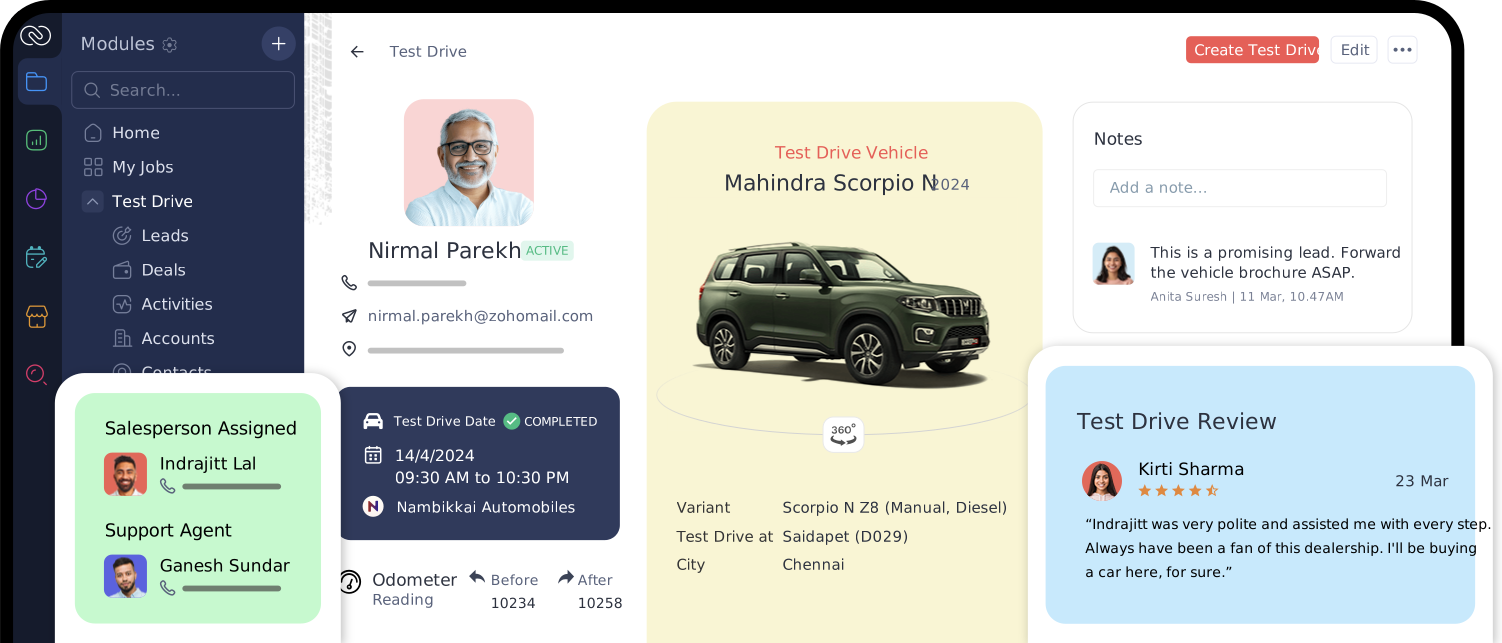
Zoho CRM: Complete Customer Management Solution
Zoho CRM: Complete Customer Management Solution
Zoho CRM dashboard showing lead management, contact tracking, and sales pipeline visualization
Zoho CRM is the crown jewel of Zoho's product suite, competing directly with Salesforce and HubSpot in the global CRM market. With over 250,000 businesses using Zoho CRM worldwide, it has captured approximately 2.5% of the global CRM market share, making it the 4th largest CRM provider globally. The platform serves everything from small businesses to Fortune 500 companies, with notable customers including Amazon, Netflix, and Tesla.
Key Features & Capabilities:
- •AI-powered sales assistant (Zia) for predictive analytics
- •Multi-channel communication (email, phone, social media)
- •Advanced workflow automation and lead scoring
- •Customizable dashboards and reporting
- •Mobile-first design with offline capabilities
- •Integration with 500+ third-party applications
- •Advanced security with SOC 2 Type II compliance
Pricing & Market Position:
Pricing: Starts at $14/user/month (Standard) vs Salesforce's $25/user/month
Market Share: 2.5% of global CRM market (2025)
Growth Rate: 25% year-over-year revenue growth
Customer Satisfaction: 4.2/5 rating on G2 Crowd
Best Use Case:
Mid-market companies (50-500 employees) looking for enterprise-grade CRM functionality at SMB pricing, with strong customization needs and multi-channel customer engagement requirements.
2.1.2 Zoho One: The Operating System for Business

Zoho One: The Complete Business Operating System
Zoho One: The Complete Business Operating System
Zoho One comprehensive suite showing all integrated applications for unified business management
Zoho One represents Zoho's most ambitious product—a comprehensive business operating system that includes 55+ integrated applications for just $37/user/month. This all-in-one solution has revolutionized how businesses approach software procurement, eliminating the need for multiple vendors and reducing integration complexity. With over 50,000 businesses using Zoho One globally, it has become a preferred choice for companies seeking unified business management.
Core Applications Included:
Sales & Marketing:
- • Zoho CRM
- • Zoho Campaigns
- • Zoho SalesIQ
- • Zoho Social
Finance & Operations:
- • Zoho Books
- • Zoho Inventory
- • Zoho Invoice
- • Zoho Expense
HR & Collaboration:
- • Zoho People
- • Zoho Cliq
- • Zoho Mail
- • Zoho WorkDrive
Development & Analytics:
- • Zoho Creator
- • Zoho Analytics
- • Zoho Flow
- • Zoho Forms
Market Impact & ROI:
Cost Savings: Average 60% reduction in software costs compared to best-of-breed solutions
Implementation Time: 70% faster deployment than multi-vendor solutions
Data Integration: 100% native integration eliminates data silos
Customer Satisfaction: 4.5/5 rating for unified experience
Best Use Case:
Growing businesses (25-1000 employees) looking to consolidate their software stack, reduce vendor management complexity, and achieve better data integration across all business functions.
2.1.3 Zoho Creator: Low-Code Development Platform
Zoho Creator is Zoho's low-code/no-code platform that enables businesses to build custom applications without extensive programming knowledge. In the rapidly growing low-code market (projected to reach $65 billion by 2027), Zoho Creator has carved out a significant niche, serving over 4 million users globally. The platform competes directly with Microsoft PowerApps, Salesforce Lightning Platform, and Appian, offering a more affordable and user-friendly alternative.
Zoho Creator: Low-Code Development Platform Demo
Zoho Creator: Low-Code Development Platform Demo
Watch how Zoho Creator enables businesses to build custom applications without extensive programming knowledge using drag-and-drop interface
Click to play video demonstration
Key Capabilities:
- •Drag-and-drop application builder with visual interface
- •Pre-built templates for common business applications
- •AI-powered form generation and data analysis
- •Mobile app generation from web applications
- •Advanced workflow automation and business process management
- •Integration with 500+ external applications and APIs
- •Multi-tenant architecture for SaaS applications
Market Position & Pricing:
Zoho Creator
Starting at $10/user/month
4M+ users globally
2.5% market share
Microsoft PowerApps
Starting at $20/user/month
15M+ users globally
15% market share
Best Use Case:
Non-technical business users and small development teams looking to build custom business applications quickly without extensive coding knowledge, with strong integration needs.
2.1.4 Zoho Financial Suite: Accounting & Finance
Zoho's financial suite, led by Zoho Books, has become a formidable competitor to QuickBooks and Xero in the small business accounting market. With over 2 million businesses using Zoho's financial products globally, the suite has captured approximately 3% of the global accounting software market. The integrated approach allows businesses to manage everything from invoicing to inventory to expense management in a single platform.
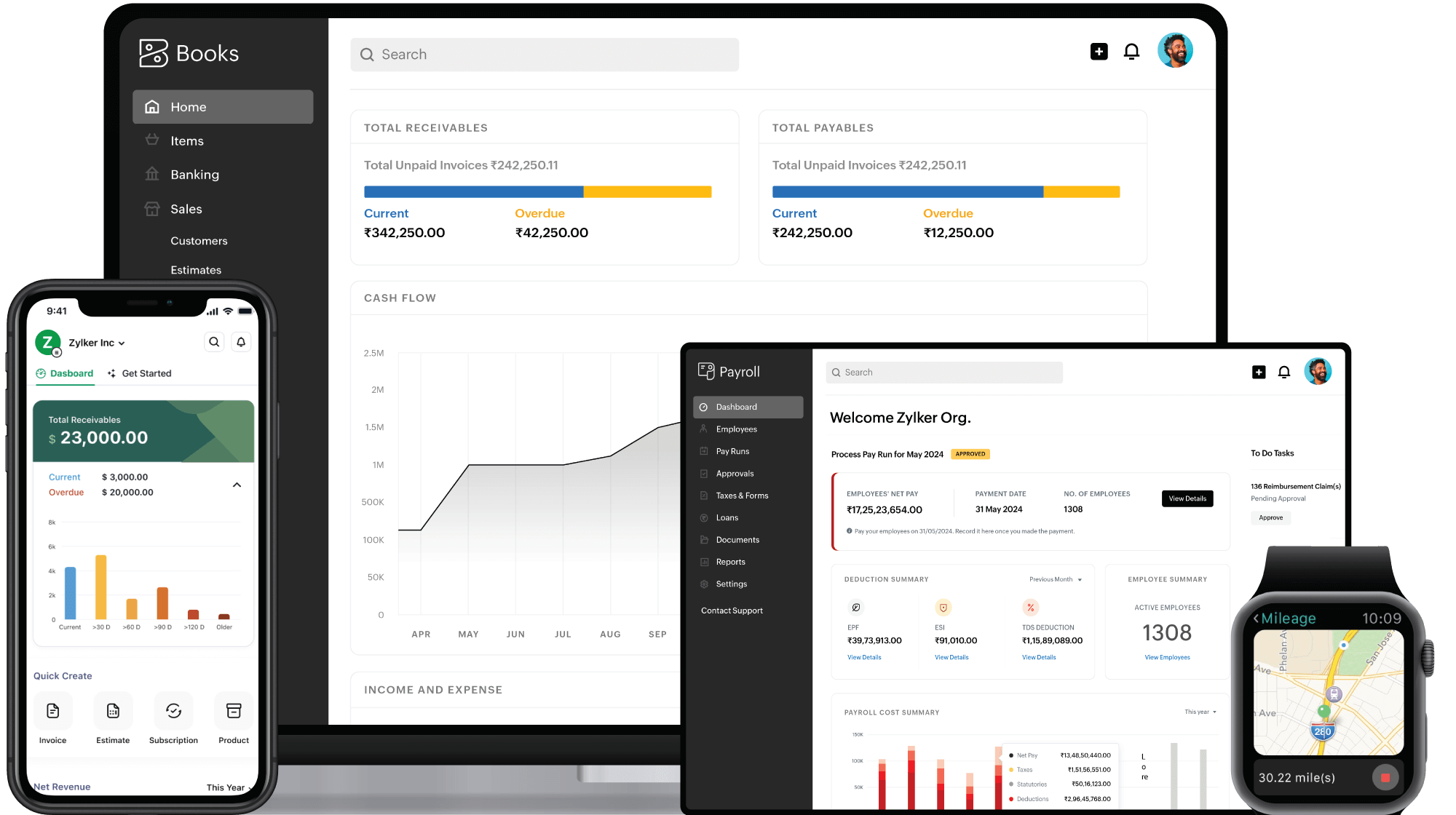
Zoho Financial Suite: Integrated Accounting & Finance Solutions
Zoho Financial Suite: Integrated Accounting & Finance Solutions
Comprehensive financial management platform showing Zoho Books, Invoice, Expense, and Inventory across multiple devices
Financial Products Portfolio:
Zoho Books
Complete accounting solution with invoicing, expense tracking, and financial reporting
Zoho Invoice
Streamlined invoicing and payment collection for freelancers and small businesses
Zoho Expense
Employee expense management with receipt capture and approval workflows
Zoho Inventory
Inventory management with order fulfillment and multi-channel selling
Market Performance:
2M+
Active Users
3%
Market Share
$200M+
Annual Revenue
Best Use Case:
Small to medium businesses (1-100 employees) looking for integrated financial management with strong inventory and multi-channel selling capabilities.
2.1.5 Zoho Arattai: Team Communication & Collaboration
Zoho Arattai is Zoho's team communication and collaboration platform, designed to compete with Slack, Microsoft Teams, and Discord in the enterprise communication space. Launched in 2021, Arattai (meaning 'chat' in Tamil) represents Zoho's commitment to building products that serve global audiences while maintaining their Indian roots. The platform has quickly gained traction with over 100,000 teams using it for internal communication and collaboration.
Key Features & Capabilities:
- •Real-time messaging with channels and direct messages
- •Voice and video calling with screen sharing
- •File sharing and collaboration tools
- •Integration with all Zoho applications
- •Custom emojis and reactions for team engagement
- •Advanced search and message threading
- •Mobile apps for iOS and Android
- •End-to-end encryption for security
Market Position & Pricing:
100K+
Active Teams
Free
Basic Plan
$1/user
Pro Plan
Competitive Advantages:
Native Integration: Seamless integration with all 55+ Zoho applications
Cost Effective: Free for up to 25 users, significantly cheaper than competitors
Privacy Focus: No data mining or advertising, following Zoho's privacy-first approach
Cultural Sensitivity: Built with understanding of diverse global team dynamics
Best Use Case:
Teams already using Zoho applications who want seamless communication integration, or organizations looking for a cost-effective alternative to Slack/Teams with strong privacy guarantees.
2.2 Freshworks: Customer Experience Pioneer
Freshworks, founded in 2010 by Girish Mathrubootham and Shan Krishnasamy, has become a global leader in customer experience software. The company's IPO in 2021 was a landmark moment for Indian SaaS companies, proving that Indian products could achieve global recognition and investor confidence. Freshworks' success is built on its focus on customer experience and its ability to build products that are both powerful and easy to use.
Key Features:
- •Customer service and support software
- •Sales CRM and marketing automation
- •IT service management tools
- •AI-powered insights and automation
- •Multi-channel customer engagement
Pros:
- ✅User-friendly interface and design
- ✅Strong focus on customer success
- ✅Comprehensive customer experience suite
- ✅AI-powered automation and insights
- ✅Global customer base and support
Cons:
- ❌Can be expensive for small businesses
- ❌Limited customization options
- ❌Integration challenges with legacy systems
- ❌Steep learning curve for advanced features
Best Use Case:
Companies looking to improve customer experience with modern, AI-powered tools that are easy to implement and use.
2.3 Razorpay: Fintech Revolution
Razorpay, founded in 2014 by Harshil Mathur and Shashank Kumar, has revolutionized digital payments in India and beyond. The company's payment gateway and financial services platform now processes billions of dollars in transactions annually. Razorpay's success lies in its developer-first approach and its ability to simplify complex financial operations for businesses of all sizes.
Key Features:
- •Payment gateway for online transactions
- •Payment links and QR codes
- •Subscription and recurring payments
- •Banking and lending services
- •API-first architecture for developers
Pros:
- ✅Developer-friendly APIs and documentation
- ✅Comprehensive payment solutions
- ✅Strong security and compliance
- ✅Easy integration and setup
- ✅Growing ecosystem of financial services
Cons:
- ❌Limited international payment options
- ❌Transaction fees can add up
- ❌Complex regulatory requirements
- ❌Dependency on banking partners
Best Use Case:
Online businesses and developers looking for a comprehensive payment solution that's easy to integrate and scale.
2.4 BrowserStack: Testing Infrastructure Leader
BrowserStack, founded in 2011 by Ritesh Arora and Nakul Aggarwal, has become the go-to testing platform for developers worldwide. The company's cloud-based testing infrastructure is used by tech giants like Microsoft, Google, and Facebook, as well as thousands of smaller companies. BrowserStack's success demonstrates how Indian companies can build technical infrastructure that serves the global developer community.
Key Features:
- •Cross-browser testing on real devices
- •Automated testing and CI/CD integration
- •Mobile app testing on real devices
- •Visual testing and screenshot comparison
- •API testing and performance monitoring
Pros:
- ✅Real device testing capabilities
- ✅Comprehensive browser and device coverage
- ✅Easy integration with development workflows
- ✅Reliable and fast testing infrastructure
- ✅Strong developer community and support
Cons:
- ❌Can be expensive for high-volume testing
- ❌Limited customization options
- ❌Dependency on internet connectivity
- ❌Learning curve for advanced features
Best Use Case:
Development teams and QA engineers who need reliable cross-browser and cross-device testing capabilities.
2.5 Postman: API Development Platform
Postman, founded in 2014 by Abhinav Asthana, has become the world's most popular API development platform. The company's tools are used by over 20 million developers worldwide to design, test, and document APIs. Postman's success showcases how Indian companies can build developer tools that become essential infrastructure for the global tech community.
Key Features:
- •API testing and development environment
- •Collaborative API development tools
- •API documentation and mocking
- •Automated testing and monitoring
- •Integration with popular development tools
Pros:
- ✅Intuitive and user-friendly interface
- ✅Comprehensive API development features
- ✅Strong collaboration and team features
- ✅Extensive integrations and ecosystem
- ✅Free tier with generous limits
Cons:
- ❌Can be resource-intensive for large APIs
- ❌Limited offline capabilities
- ❌Pricing can be high for enterprise features
- ❌Learning curve for advanced automation
Best Use Case:
Development teams and API developers who need a comprehensive platform for API development, testing, and collaboration.
Conclusion
India's transformation from a service economy to a product powerhouse represents one of the most remarkable success stories in global technology. The journey from being the world's back office to becoming a hub of innovation and product excellence has been nothing short of extraordinary.
As we look to the future, India's tech product ecosystem is poised for even greater heights. With continued government support, growing investor confidence, and an ever-expanding talent pool, the next decade promises to bring even more innovative products that will shape the global technology landscape.